🎁 Welcome to UKSG Tools Enjoy 5% off your first order — use code DISCOUNT5 at checkout.
🔔 Shipping Information: ✔Fast Delivery: 5–10 days (available for an additional fee). ✔Express Shipping (EMS): 7-12 days (available on orders over $200 and in-stock items). ✔Standard Shipping: 10-16 days (orders under $200 and in-stock items). ✔Backorder Delivery: 30 days for items not in stock, as they require additional production time. Delivery cost and estimated time are calculated automatically during checkout. Reduced customs duties where applicable.
📲 Stay Connected! Follow us on Instagram to keep up with all the latest news and special offers.
How to choose a really good knife: 5 signs by which experts distinguish quality
A good knife is not just a tool. It is an extension of the hand of a craftsman, chef or hunter. But how to understand that the knife is really of high quality, and not just «looks nice»?
We have been working with professional knives, sharpening CBN and Diamond tools from UKSG.tools for over 10 years, so we know exactly what a quality blade looks like. So, let’s break it down point by point.
The main indicator of quality is the type and processing of steel.
A good knife is made of hardened steel with an optimal hardness balance (59-67+ HRC). It holds a sharpening, but does not crumble under load.
A bad knife is soft (up to 56 HRC) or, on the contrary, too brittle. After a couple of cuts, it becomes dull or breaks.
Tip: VG-10, AUS-8, Sandvik 14C28N steels are excellent for kitchen knives. For carpentry and tourist knives — D2, N690, 440C. It is important that the steel is not over-hardened, otherwise the knife will be brittle.
2. Sharpening and blade geometry
Sharpness is more than just a «razor edge». It matters at what angle and how the blade is sharpened.
A good knife easily cuts paper, vegetables, cords without effort. Its edge is even, with no micro splinters.
A bad knife often has uneven sharpening, dull after the first few days.
It happens in production: good steel and good hardening, but the knife cuts badly because of poor factory sharpening. That’s where you need UKSG Tools sharpening stones
Tip: regular dressing on UKSG.tools diamond and CBN stones will keep the aggressive cutting edge for a long time — the key to a knife’s longevity and sharpness. Use guided sharpening systems UKSG.tools with sharpening stones to maintain perfect geometry.
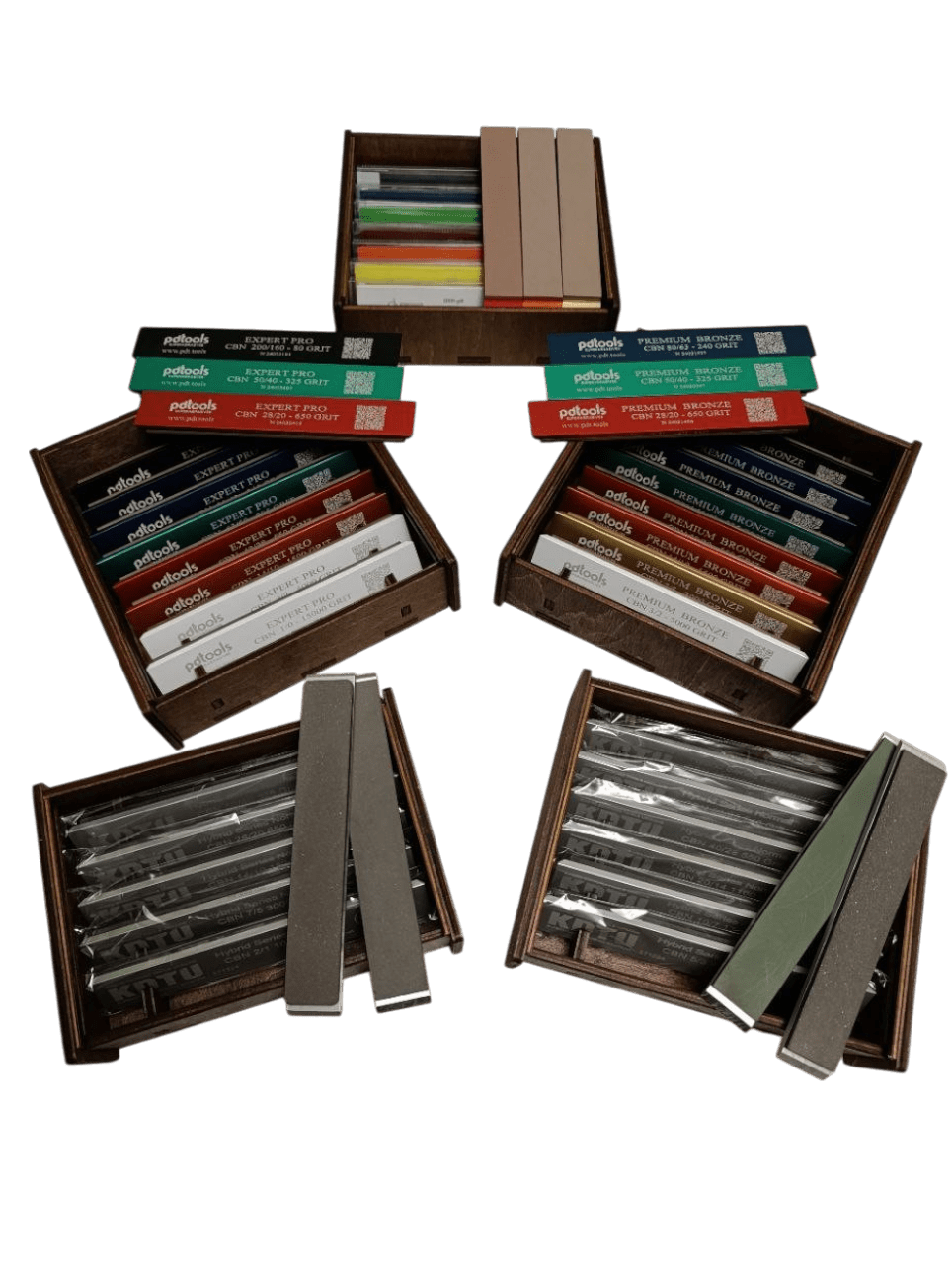
CBN Sharpening Sets
3. The handle is an extension of the hand
Convenience is what separates a good knife from just a good-looking knife.
A good handle is ergonomic, with a centered balance. Materials — micarta, wood, G10, carbon fiber.
A bad handle — slippery, cheap plastic, looseness or cracks quickly.
Tip: hold the knife in your hand — if you feel confidence and control, then this is your tool.
4. Balance and assembly
Try the knife for weight:
If the center of gravity is shifted to the blade – the knife is designed for power cutting.
If it’s toward the handle, it’s for precision movements.
The main thing — no wobbles or gaps between the blade and the handle. Poor assembly is the first sign of a cheap tool.
5. Brand reputation and service
A quality knife is always behind the name, not the other way around.
Manufacturers who control every stage of production guarantee consistent quality.
But nameless models with marketing promises like «super steel X1000» often turn out to be fakes.
Tip: choose trusted brands and stores where you can specify the origin of the steel, sharpening angle and processing.
Bottom line: a good knife is a balance
An ideal knife combines durability, sharpness, comfort and reliability. It does not have to be the most expensive, but it must be balanced in all parameters.
And to ensure that even the best knife lasts for decades, care for it properly: wash it by hand, dry it immediately after use and sharpen it on reliable UKSG.tools systems.
Want to know which sharpening stone is right for your knife? Check out our «Sharpening Stones for Knives» section at https://www.uksg.tools/shop/stones/ or drop us a chat on the website — we can tell you in 2 minutes how to find the right set for your steel and task.
FAQ: Frequently asked questions about choosing and sharpening knives
– How do I check the hardness of a knife?
The most reliable way is to find out the HRC (Rockwell) value. It is often specified by the manufacturer. If it is not, it is indirectly judged by the resistance to sharpening: soft steel dulls quickly and bends easily.
– What does HRC mean?
HRC (Hardness Rockwell C) is a unit of measurement for the hardness of a metal.
For example:
52 HRC — a soft knife (budget knife, dulls quickly).
58 HRC — universal option for the kitchen.
61-67+ HRC — premium blades, keep an edge longer.
– How do you check if your knife is sharp?
A simple test is to cut paper or tomatoes. A good knife cuts effortlessly, does not crumple the edge or «chew».
– How do you care for your knife?
Wash by hand, not in the dishwasher.
Wipe dry after washing.
Store on a magnetic bar or in a stand.
Regularly maintain the edge with UKSG.tools sharpening stones.
– How often should a knife be sharpened?
For daily use, the knife should be sharpened once every 2 days. For this purpose, a mussat (honing rod) or pastes with a cast iron lapping tool https://www.uksg.tools/shop/polishing-tools/ are suitable, and we recommend sharpening once every 2 weeks. It is better to sharpen a little and regularly than rarely and «to zero».
Oleksandr Doroshenko
Oleksandr Doroshenko is the leader and principal expert at UKSG Tools, a Ukrainian manufacturer of specialized sharpening and grinding instruments. Under his leadership, the company focuses on high-precision solutions using diamond and CBN abrasives, blending advanced technologies with the craftsmanship of the country’s finest domestic producers.