🎁 Welcome to UKSG Tools Enjoy 5% off your first order — use code DISCOUNT5 at checkout.
🔔 Shipping Information: ✔Fast Delivery: 5–10 days (available for an additional fee). ✔Express Shipping (EMS): 7-12 days (available on orders over $200 and in-stock items). ✔Standard Shipping: 10-16 days (orders under $200 and in-stock items). ✔Backorder Delivery: 30 days for items not in stock, as they require additional production time. Delivery cost and estimated time are calculated automatically during checkout. Reduced customs duties where applicable.
📲 Stay Connected! Follow us on Instagram to keep up with all the latest news and special offers.
Choosing a sharpening stone is like choosing a tool for your kitchen or workshop: if you want excellent results, you need to understand the details. This is especially true when it comes to CBN and diamond stones, the two top options for high-quality sharpening.
But which one should you choose? How do they differ? What does the grain size system on them mean? How do you properly open a new sharpening stone and then care for it so that it doesn’t turn into a useless brick?
In this article, we will break everything down without complicated terms and marketing jargon. We will go over the differences, explain what is important to consider when buying, and give clear advice on use and care. So that your sharpening is always not just sharp, but professional.
Ready? Let’s go!
Diamond bars from UKSG.tools — sharpen with confidence
Due to their hardness, diamonds have been used as abrasive materials since ancient times. These were mainly small diamond chips, rather than the whole stones we see today.
Modern diamond stones for sharpening appeared as a result of developments in diamond processing technology and the production of binding materials. Specialists developed methods for baking superabrasives in various bindings: resin, hybrid, metal and others. This led to the creation of convenient and effective sharpening tools.
Synthetic diamonds, rather than natural ones, are used to manufacture diamond sharpening stones. Modern technology allows diamonds to be grown in laboratory conditions. In terms of hardness, strength and abrasiveness, they are almost as good as natural diamonds, but are significantly cheaper. The variety of grain sizes and shapes allows for the creation of diamond bars with different grain sizes for all stages of sharpening, from rough processing to finishing.
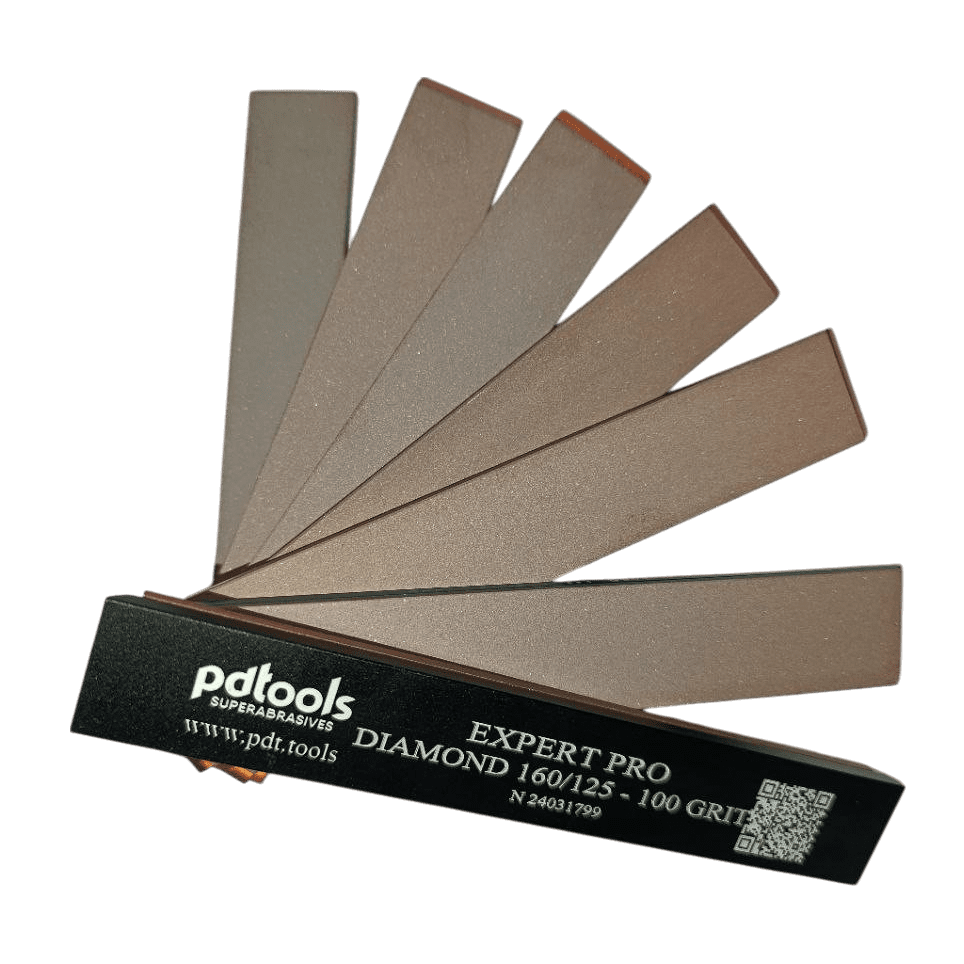
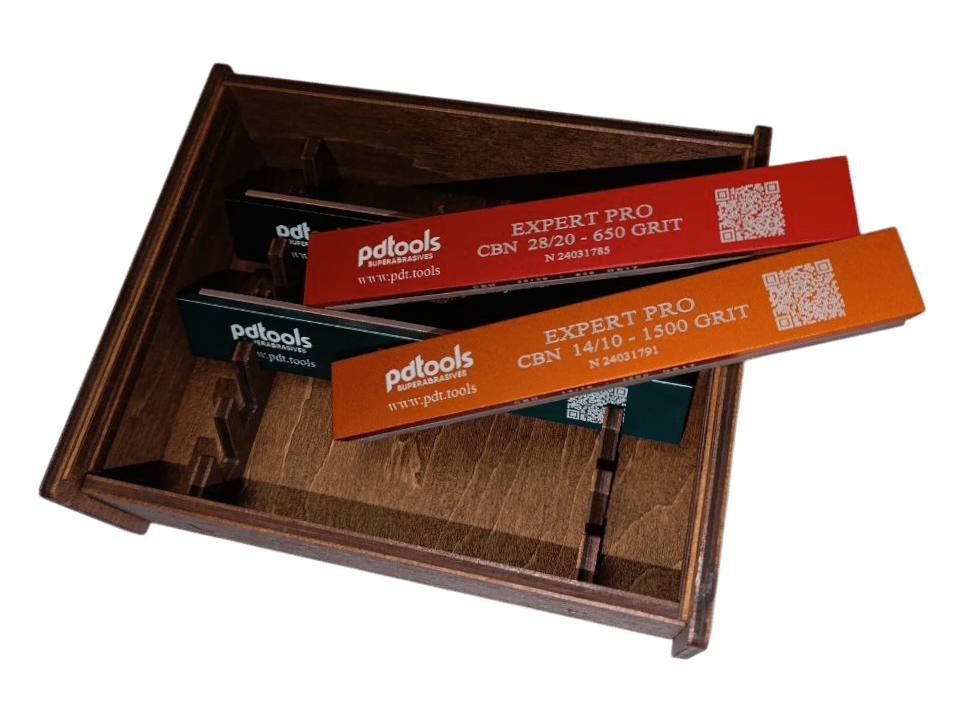
Poltava Expert Pro Diamond Stone (Resin Bond)
We offer super-abrasive diamond tools for sharpening from the manufacturers PDTools (Poltava Diamond Tools) and KDTU (Kyoto Diamond Tools Ukraine). Thanks to our direct cooperation with the factories, we are able to offer affordable prices to our customers and partners.
CBN stones — sharpening at a new level
CBN (cubic boron nitride) or elbor is a synthetic superhard material that is similar in hardness to diamond but has higher heat resistance. It consists of boron (43.6%) and nitrogen (56.4%).
In 1957, a researcher at General Electric synthesised CBN for industrial purposes. Interestingly, General Electric was founded in 1892 as a result of the merger of companies owned by American inventor Thomas Edison. The corporation is known for its innovations in energy, healthcare, transportation and other fields. Later, when the excellent abrasive properties of CBN were discovered, it began to be used in grinding stones.
CBN is almost as hard as diamond.
It has better heat resistance and is less prone to chemical interaction with iron and steel at high temperatures.
Ideal for hard steels (60+ HRC, including powdered steel).
Works ‘cold’ — does not overheat the edge.
It lasts a very long time.
Suitable for both sharpening and polishing (in combination with the appropriate grit type).
CBN and diamonds are both super-abrasives, harder than most steels.
Which steels are they best for?
Diamonds are best for ordinary and stainless steels (up to 61 HRC).
CBN is ideal for hard and powder steels (61–71+ HRC).
Wear
Diamonds wear out faster on hard steels.
CBN lasts longer, especially at high HRC.
Performance
Diamonds — aggressive removal, fast but rough.
CBN — stable abrasive, produces a smoother edge.
What to choose?
For beginners — diamonds.
For professionals and craftsmen — CBN, especially for powder steels.
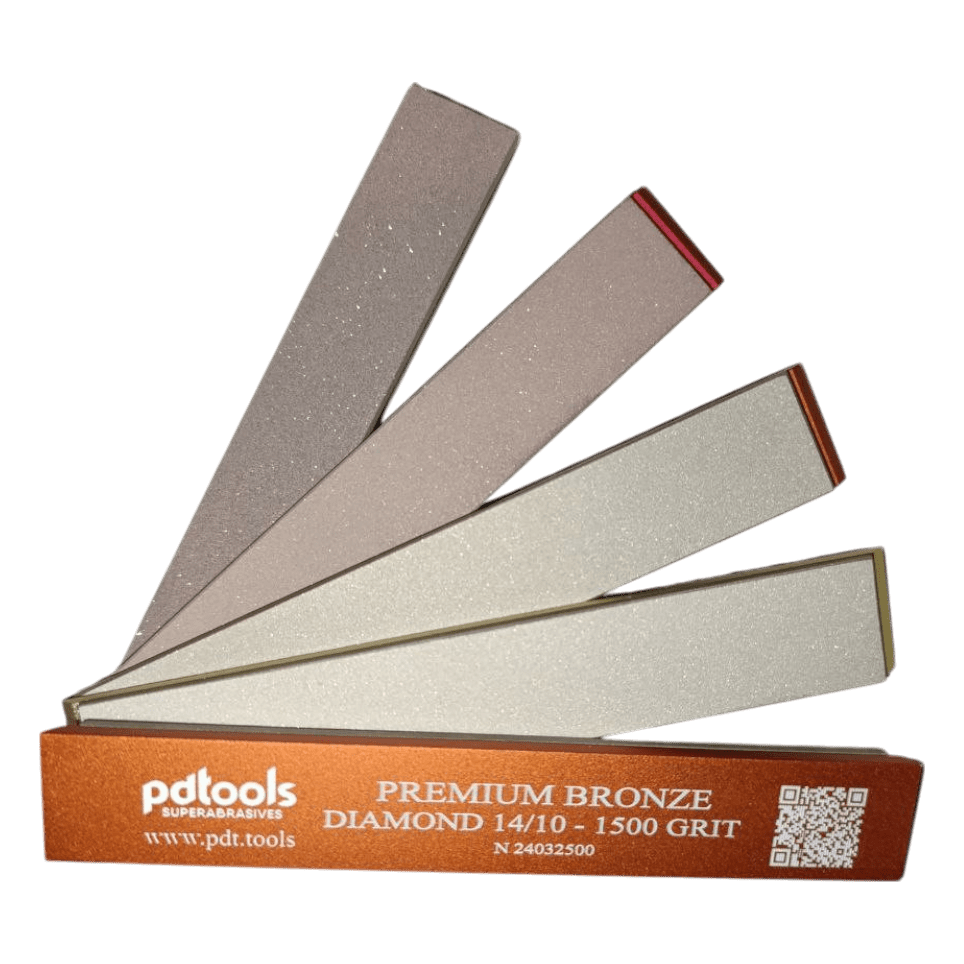
PDT Premium Bronze Diamond Stone with metal bond
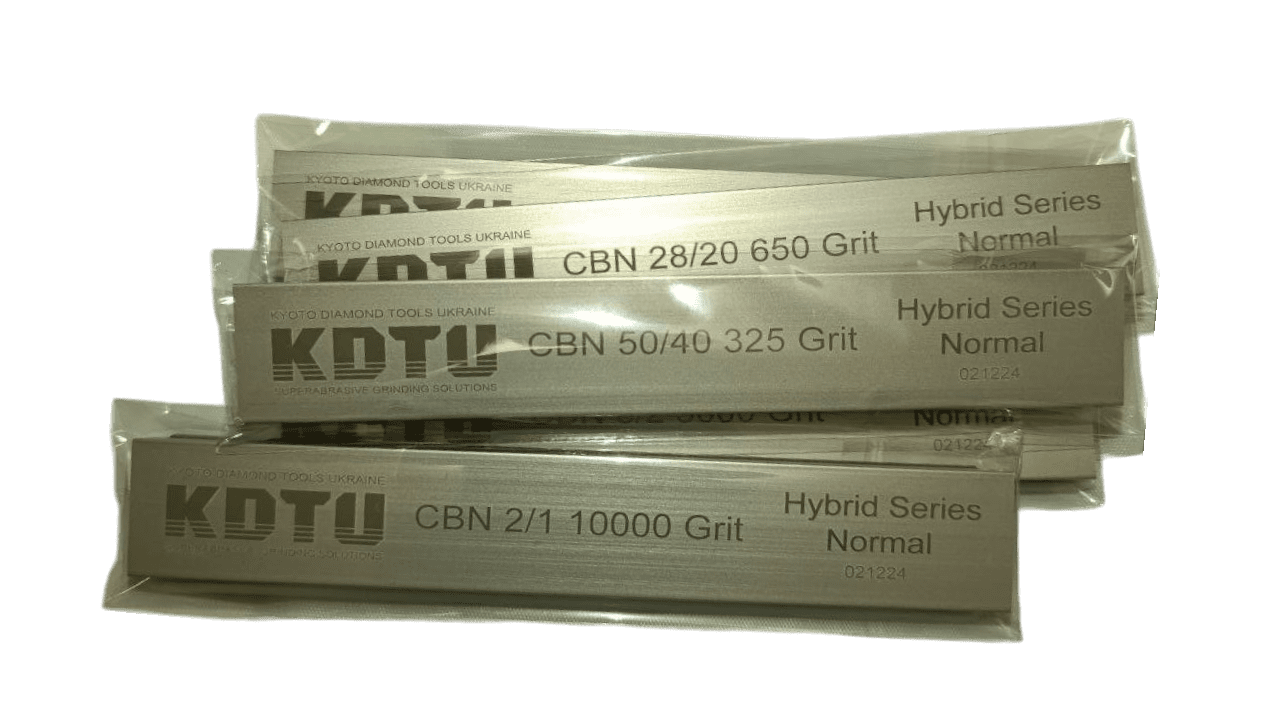
KDTU CBN Stones Hybrid Series
Main types of diamond and CBN stones — what to look for
There are two main types of diamond and CBN stones: bonded stones and electroplated stones. The choice between them depends on the task, the type of steel and the user’s level of expertise.
Bonded stones
A sintered coating is obtained when diamond or CBN grains are embedded in a binding material, which is then sintered. The advantage of sintered stones is their high resource, polishing capabilities and the ability to select stones for different types of tasks.
The abrasive grains in sintered stones are evenly distributed in a volumetric bond (resin, hybrid, metal, vitrified).
30% of the abrasive (diamond or CBN) protrudes from the bond.
The grains gradually open up during the sharpening process.
After removing the steel with the abrasive, the bond itself smoothes out the pattern (the softer the bond, the better the polishing). This results in a more beautiful edge and less wear on the knife blade.
Advantages
Durability: can be used until the entire layer thickness is worn out.
Can be restored/levelled.
Different types of bonds — for any task: polishing, finishing, rough sharpening.
Nuances
Requires proper care, especially resin.
Over time, the surface needs to be flattened.
The price is higher, but the service life is longer.
Sintered stones are considered a professional choice. They have a service life 30 times longer than their electroplated counterparts.
Electroplated Diamond Plate
Electroplating is achieved when diamond or CBN grains are bonded to a metal base bar, usually with nickel. It tightly envelops and securely fixes the abrasive particles to the base.
Electroplated stones contain about 70% abrasive (diamond or CBN), which provides high working speed but leaves deep scratches.
There is only one working layer, which cannot be restored.
Advantages
Aggressive work.
Does not require flattening .
Excellent for rough machining and restoring severely blunt blades.
Nuances
Wears out faster than sintered stones.
Not suitable for mirror edges.
Disposable surface: when worn out, the stone no longer works.
Unlike standard electroplated stones, PDTools has developed a unique product — PDT Premium Nickel CBN Stone. These are grinding stones in which CBN grains are encapsulated in a nickel coating using an electroplated bond. This ensures that the abrasive particles are securely held in place even under high pressure or during prolonged use.
Types of abrasive grain bonds in grinding stones
Abrasive grains in grinding stones are bonded together with a special substance called a bond. It determines the strength, wear resistance and material removal rate during sharpening. Bond types are selected depending on the type of abrasive and sharpening requirements.
Resin bond in superhard abrasives such as diamond and CBN stones is typically made from synthetic resins such as phenol formaldehyde or epoxy polymers, sometimes with the addition of various metals and hardeners.
The bond is soft and polishes well
Gives a shine and a mirror-like surface when finished.
Works with water or soap solution and dry.
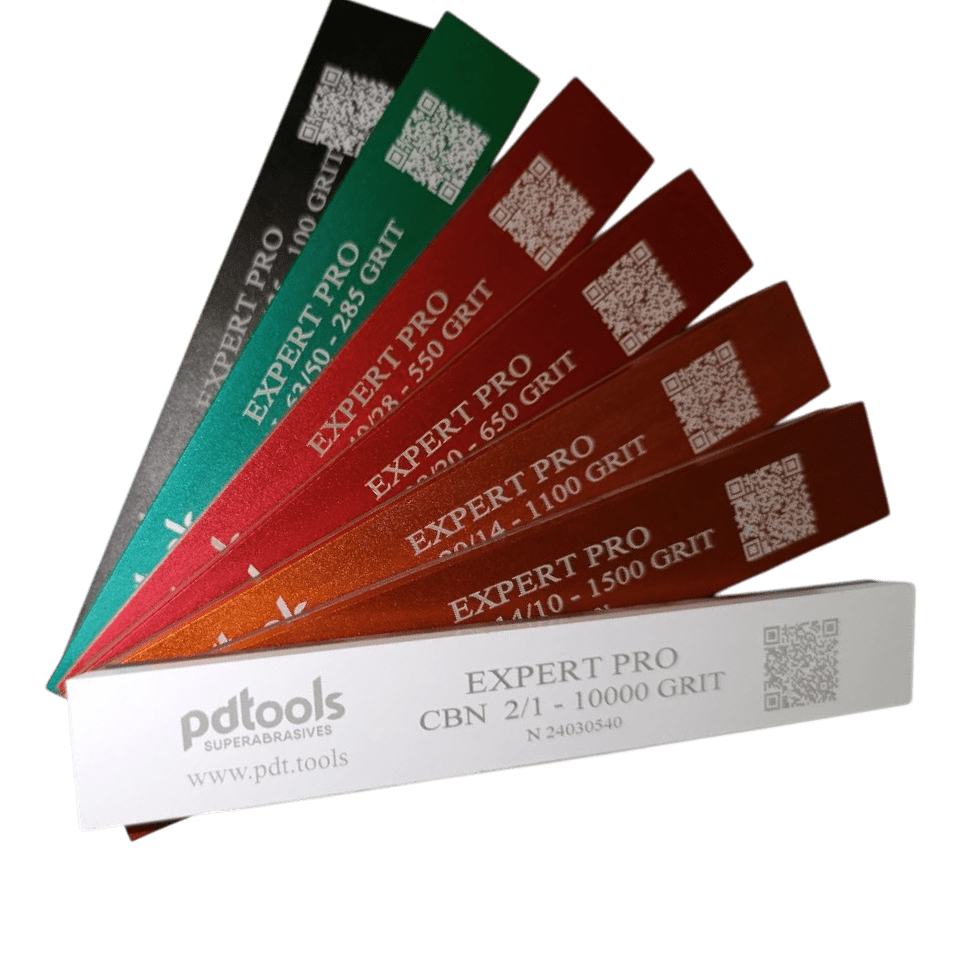
EXPERT HOME SET PDT Stones (Resin Bond)
Metal bond. It can contain various metals: tungsten, cobalt, iron, nickel, copper and tin.
The bond is hard and aggressive.
It quickly removes metal but leaves deep scratches.
It is used in the rough stages of sharpening.
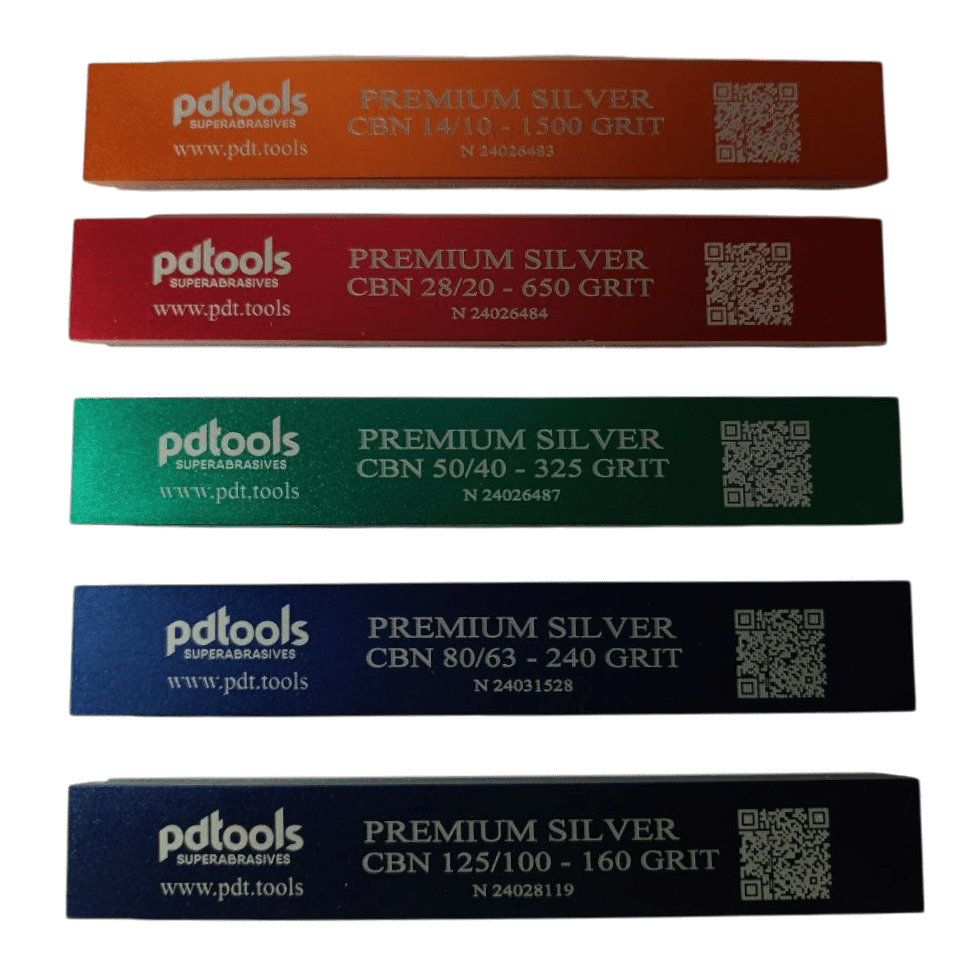
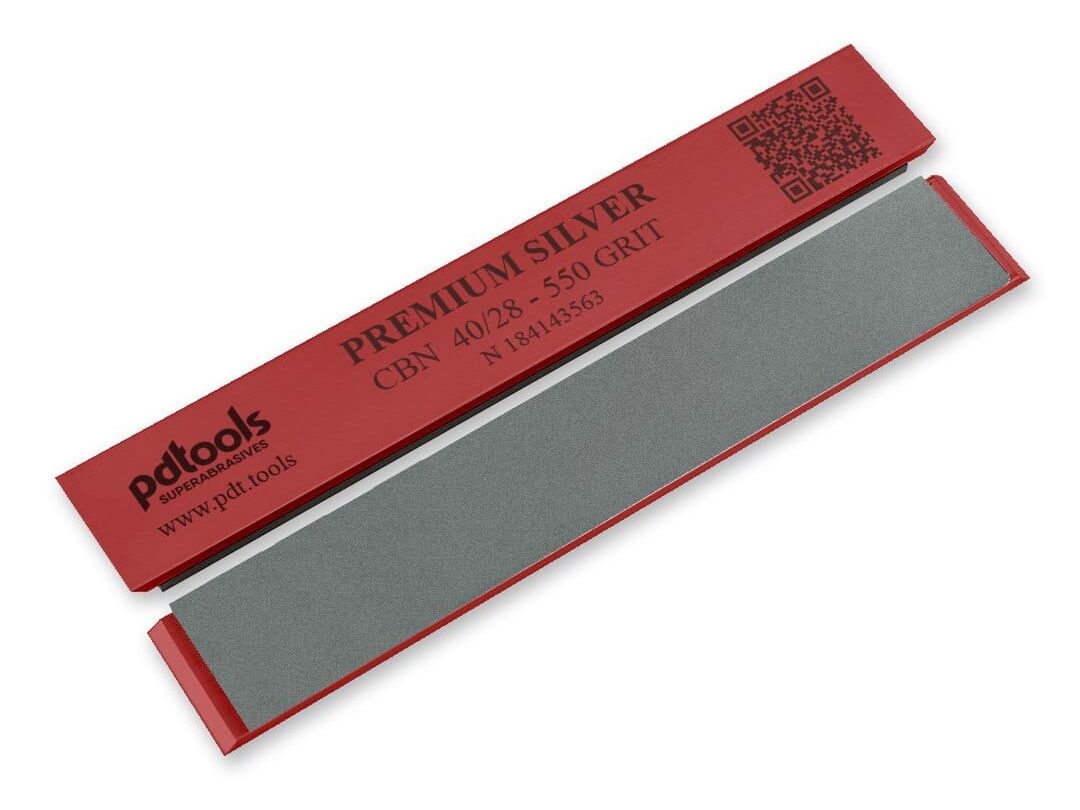
Premium Silver CBN Stone (Metal Bond), 1″ x 6″ (25mm x 150mm)
Hybrid (hybrid/metal-resin). This is a combination of different binding materials. This bond has the advantages of different types of bonds, for example, the high strength of one and the flexibility of another.
Balance between removal and edge quality.
Very wear-resistant, versatile.
Produces micro-serrations — excellent for cutting aggression. Micro-serrations are small teeth that form when sharpening a knife on whetstones, especially with coarse grain. When switching to a finer grain, the micro-serrations are smoothed out and the cut becomes smoother.
Electroplated (nickel). Abrasive grains are attached to a metal substrate using an electrolytically deposited layer of nickel.
Very fast working, no flattening required.
Aggressive, ideal for edge restoration.
Vitrified Bond (ceramic bond) consists of natural and artificial materials mixed in specific proportions. These components are fired at high temperatures, resulting in a bond with strength and hardness similar to glass. The main abrasive fillers for ceramic bonds are silicon carbide and aluminium oxide.
Hard and porous structure.
Holds its shape well and removes metal quickly.
Requires a professional approach, as the abrasive is active.
Requires care like organic materials.
Vitrified-Metal Bond — a unique PDT Premium Silver bond from PDTools
Combines the strength of metal and the stability of ceramics.
Very high removal rate and wear resistance.
Works both dry and with water and oil.
Ideal for hard steels (60–71+ HRC).
Does not require frequent maintenance.
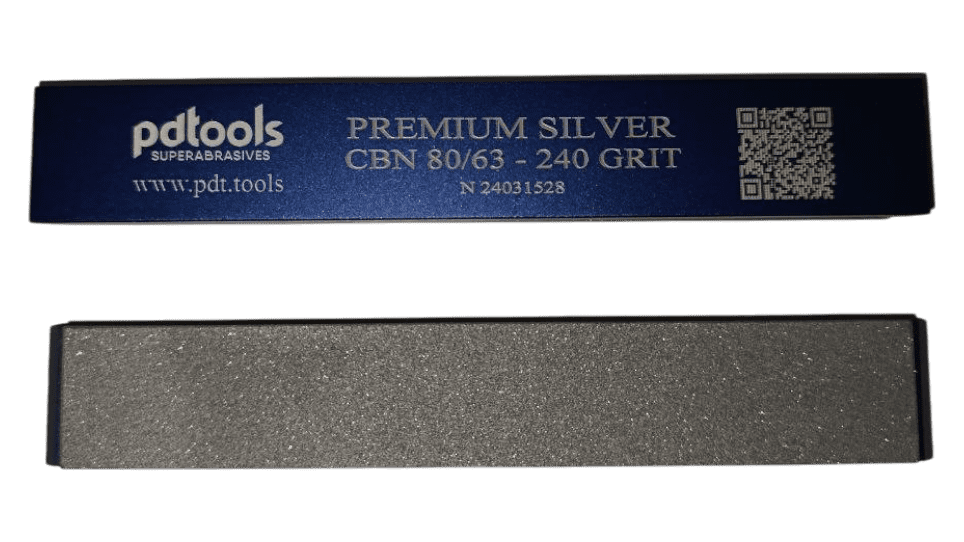
PDT Premium Silver CBN Stone (Vitrified-Metal Bond)
Advice from our experts
For beginners — resin, hybrid or electroplated (diamond plates).
For professionals — a complete set, including electroplated, hybrid and metal-ceramic bonds, vitrified.
UKSG.tools diamond and CBN bars — a tool that won’t let you down. Buy it and feel the difference!
Microns (µm) and grit — characteristics of sharpening stones
Microns (µm) and grit — both characteristics are needed to determine how coarse or soft the material of the bar is.
Grit is the number of abrasive grains per unit area; the higher the grit number, the finer the sharpening material.
Microns (µm) is the size of the abrasive particles in micrometres; the higher the number, the coarser the sharpening material.
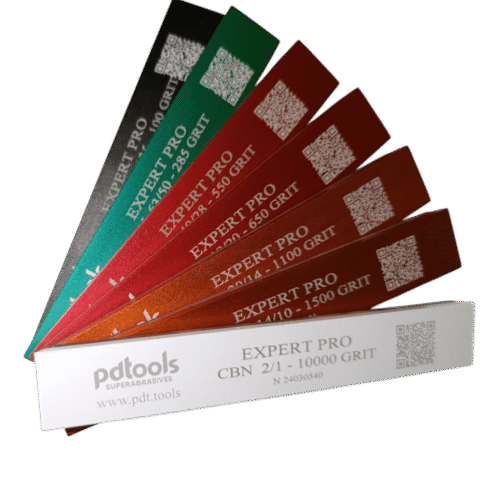
This table shows the progression from the hardest abrasive to the softest.
Thanks to the table, it is easy to determine which stone to use next when sharpening your knife. For example, if you have finished with a 650 grit stone, you can continue with a 1100 grit stone.
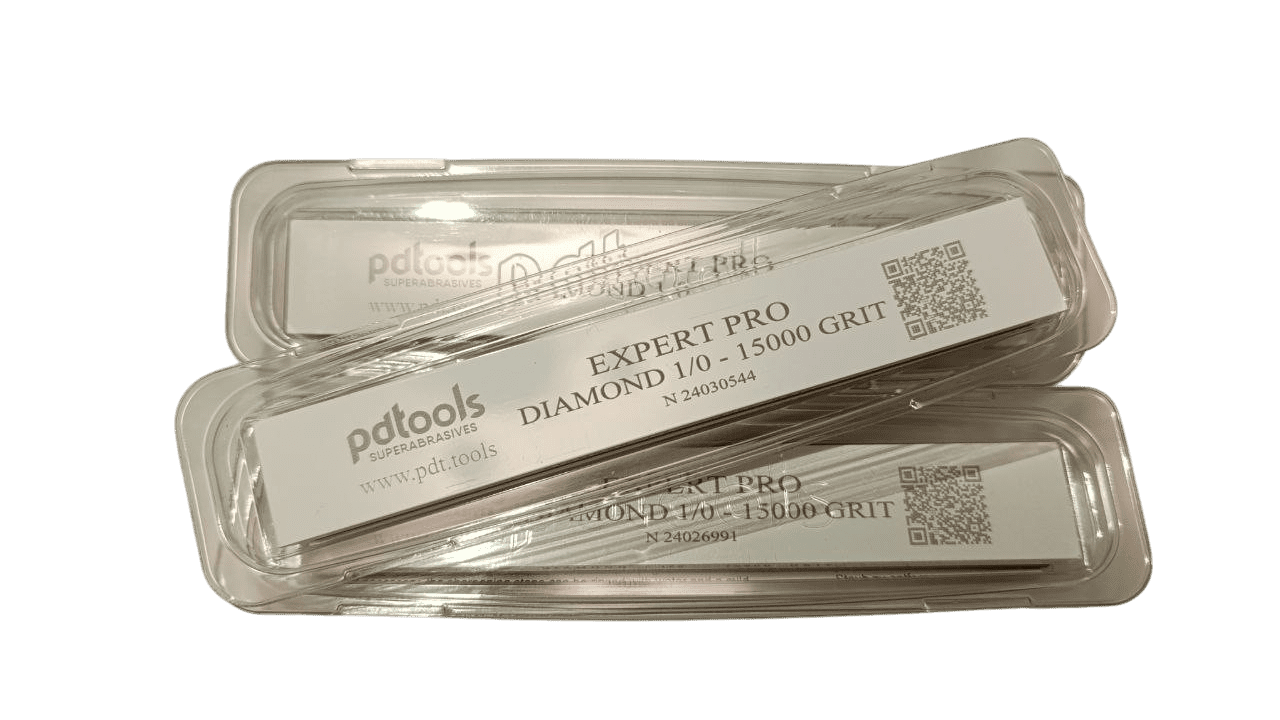
The characteristics of the stone are as follows: diamond, 1/0 micron, 15,000 grit
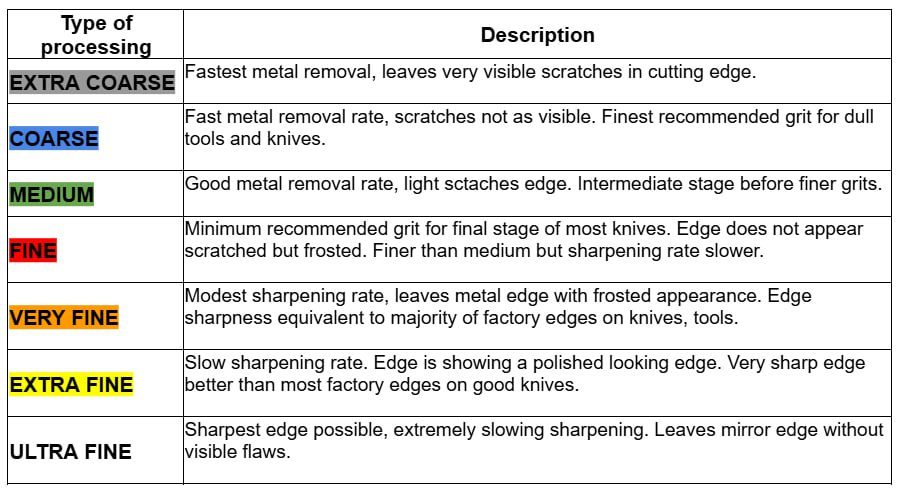
System of standards — detailed descriptio
If you find it difficult to choose a sharpening stone, our experts will help you! They will select the best set of whetstones for sharpening your knife. To do this, contact us by email at info@uksg.sale or fill out a request form on the website.
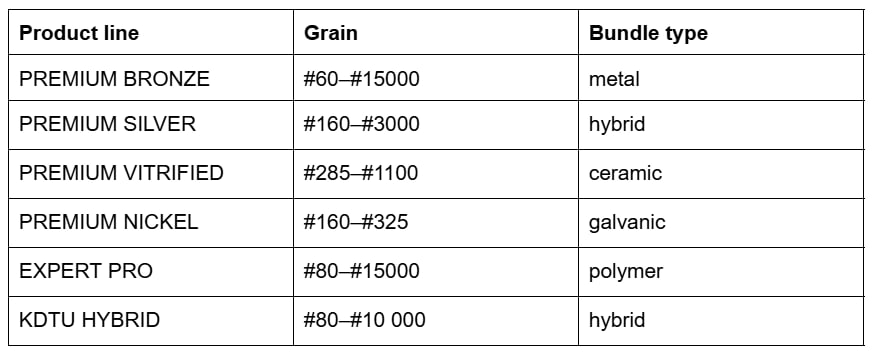
UKSG.tools — 6 premium lines of CBN sharpening stones
Each product line is designed for specific sharpening tasks.
Official distributor of PDTools and KDTU CBN Stones — 100% authentic, factory-made sharpening stones.
Sintered super abrasive technology — long-lasting performance that outperforms electroplated stones by 30 times.
Grit range — from coarse shaping to ultra-fine polishing.
Professional quality — trusted by knife manufacturers, sharpeners and professionals around the world.
Dimensions:
Compact (150 x 12 mm / 6″ x 1/2″) — ideal for curved blades and tanto-style blades.
Standard (150 x 25 mm / 6″ x 1″) — a universal size for most sharpening tasks.
Large (200 x 70 mm / 8″ x 3″) — for professional use and large blades.
Shapes:
Rectangular bars — compatible with leading sharpening systems: Apex Edge Pro, RUIXIN, TSPROF, Hapstone and others.
Bench stones — ideal for manual sharpening with excellent surface finish.
PDT Premium Silver CBN Stones (Vitrified-Metal Bond) 1″ x 6″ – High-Speed Precision for Hard Steels
Our KDTU and PDTools sharpening stones are sintered! Their working layer of bonding and abrasive is 30 times better than that of galvanised sharpening stones! Premium CBN bars — for those who value results. Sharpen with confidence!
How to break in new diamond and CBN sharpening bars?
It is necessary to ensure uniform wear of the abrasive layer of the stone. To do this, follow these tips:
When sharpening, try to move the knife across the entire surface of the bar, rather than sharpening in one place only.
Do not press too hard on the knife or bar, as this may cause the abrasive to chip.
New whetstones may remove metal more aggressively, but after sharpening several knives, they will reach their working mode.
During use, metal shavings may accumulate on the whetstone, reducing its effectiveness. Water, soapy liquid or special cleaning agents can be used for cleaning.
How to care for sharpening stones?
Caring for diamond bars and CBN stones involves keeping them clean and preventing clogging of the abrasive surface.
When sharpening, water or oil is sometimes used as a lubricant and coolant. Metal dust, oil and water clog the pores, causing the stones to become clogged. To prevent this, the stone should be washed after each sharpening.
Warm water, soap solution + soft brush or sponge (including those with an abrasive side).
Mild acid solutions (as a last resort).
Care by type of bond
Rubber (resin) — requires gentle cleaning.
Hybrid/metal — can be scrubbed vigorously.
Electrolytic (nickel) — just wash.
Drying and storage
After cleaning, dry the bars and store them in a dry place to prevent corrosion and oxidation. Do not store them wet in a box. Do not store them in direct sunlight.
By following these recommendations, you can extend the service life of your diamond bars and CBN stones and ensure effective tool sharpening.
Sharpen professionally. Choose superabrasive stones from UKSG.tools!
Oleksandr Doroshenko
Oleksandr Doroshenko is the leader and principal expert at UKSG Tools, a Ukrainian manufacturer of specialized sharpening and grinding instruments. Under his leadership, the company focuses on high-precision solutions using diamond and CBN abrasives, blending advanced technologies with the craftsmanship of the country’s finest domestic producers.