🎁 Welcome to UKSG Tools Enjoy 5% off your first order — use code DISCOUNT5 at checkout.
🔔 Shipping Information: ✔Fast Delivery: 5–10 days (available for an additional fee). ✔Express Shipping (EMS): 7-12 days (available on orders over $200 and in-stock items). ✔Standard Shipping: 10-16 days (orders under $200 and in-stock items). ✔Backorder Delivery: 30 days for items not in stock, as they require additional production time. Delivery cost and estimated time are calculated automatically during checkout. Reduced customs duties where applicable.
📲 Stay Connected! Follow us on Instagram to keep up with all the latest news and special offers.
You definitely have a good knife in your hands! One that feels like an extension of your arm: perfect cuts, no effort, complete control. But even the best knife will eventually become dull. And then one thing matters: care and regular sharpening.
We know that a knife, like any tool, deserves careful treatment. It should not be thrown into a drawer and forgotten until the first ‘problems’ arise. Proper sharpening is not just maintenance. It is a ritual. It is a return to sharpness, precision and enjoyment of work.
We have gathered everything you need to keep your knife in top condition:
Professional sharpening stones — diamond and CBN stones.
Sharpeners — for a stable angle and precise sharpening.
Recommendations from masters — articles and video instructions for beginners and professionals.
Let your knife work like it did on the first day. Start with the right stone!
A sharp knife is a safe knife!
Proper and regular knife sharpening is important for several reasons:
1. It ensures safety at work. A sharp knife cuts cleanly and predictably, reducing the risk of slipping and injury. When using a dull knife, we apply more force. This increases the likelihood of the knife slipping and cutting your fingers or hand.
2. It increases cutting efficiency. Working with a sharp knife requires less effort and time to cut. A dull knife crushes and tears food rather than cutting it.
3. It extends the life of the knife. Regular sharpening keeps the cutting edge in good condition, preventing wear and tear. When sharpened correctly, a knife can serve you for many years.
4. Guaranteed enjoyment when using. A sharp knife cuts like butter. It’s a thrill. It’s no longer just a tool, it’s the pleasure of the process!
Take care of your knife and it will serve you for years. Don’t forget to sharpen it regularly!
Sharpening methods — check, sharpen, work with pleasure
The choice of method depends on your preferences and the level of sharpening required. The main methods of sharpening at home:
Manual sharpening on stones – the classic method
Two types of stones are used for sharpening knives: natural and artificial. Natural stones include Arkansas and Japanese stones, while artificial stones include diamond, CBN and ceramic stones.
All stones for manual sharpening are made in the form of bars. They come in different sizes and grit sizes.
Coarse grit — #60-160. These bars are needed to set the correct sharpening angle and restore blunt edges.
Medium grit — #225-650 — is used for grinding the cutting edge.
The final sharpening is performed on bars with a grit of #1100-1700. This allows the knife blade to be sharpened to a razor edge, which is necessary for high-performance knives.
Ultra-fine grain — #3000-15,000 for a mirror finish and maximum precision. It is best to use resin-bonded stones. Ideally, leather/wooden slings or our new product — KDTU Mirror stones.
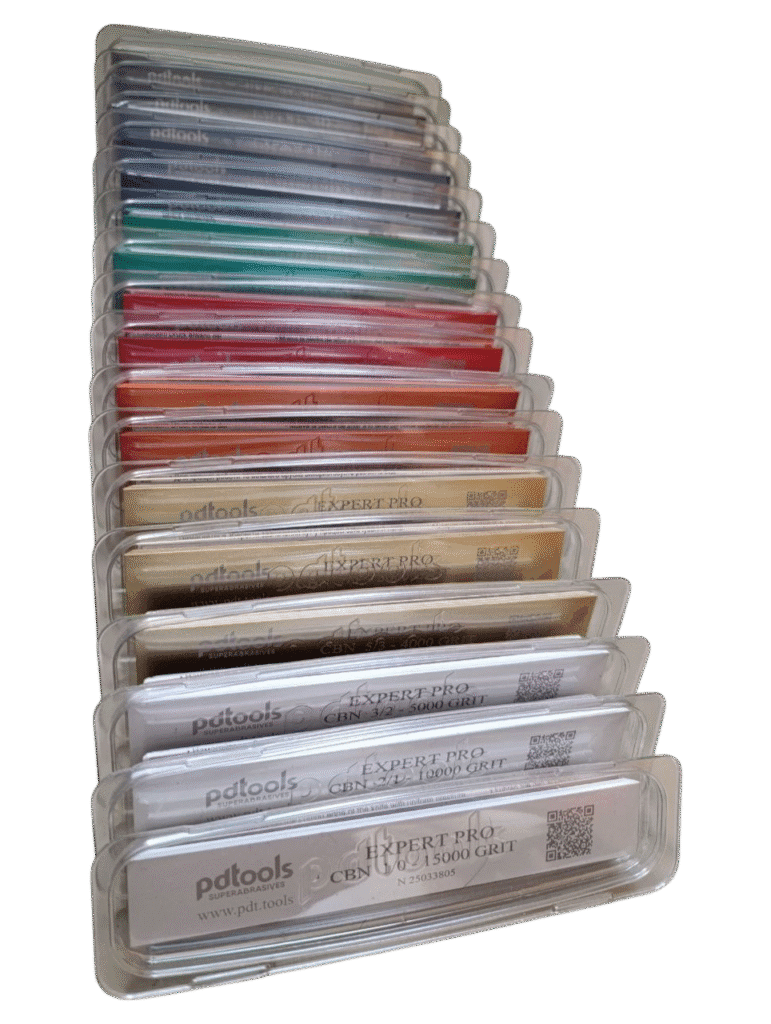
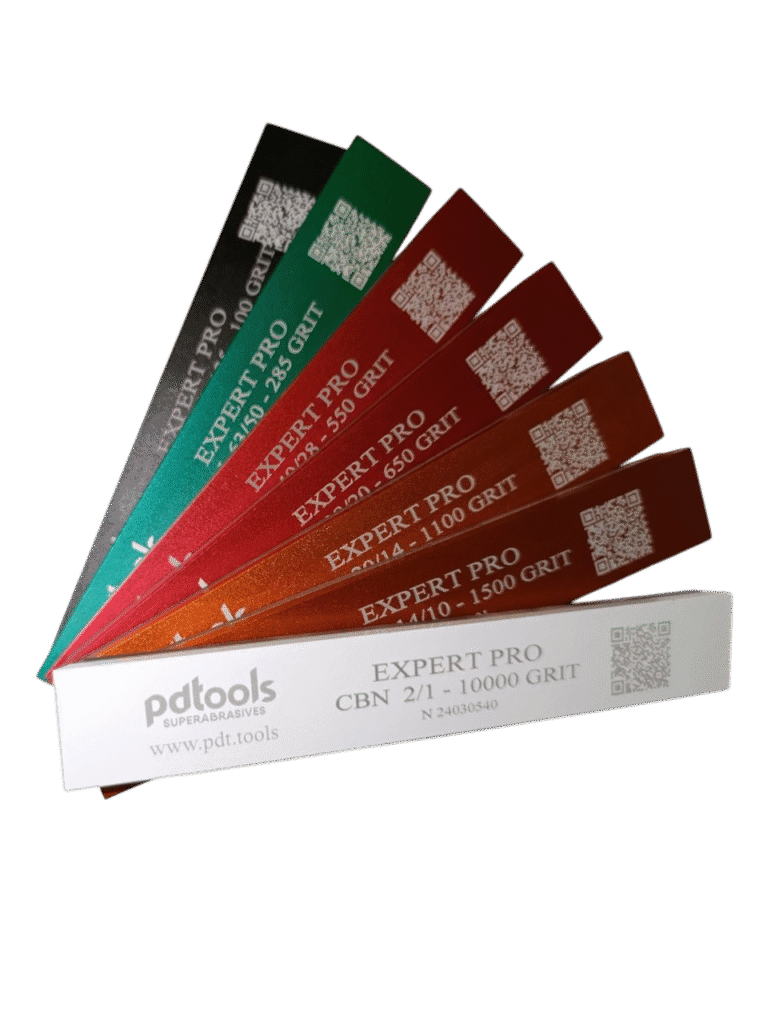
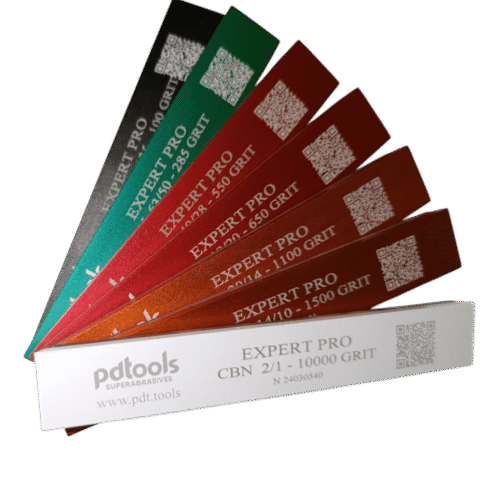
PDT Expert CBN Stone (Resin Bond) 1″ x 6″ – Precision Sharpening for Mirror-Finish Edges full.
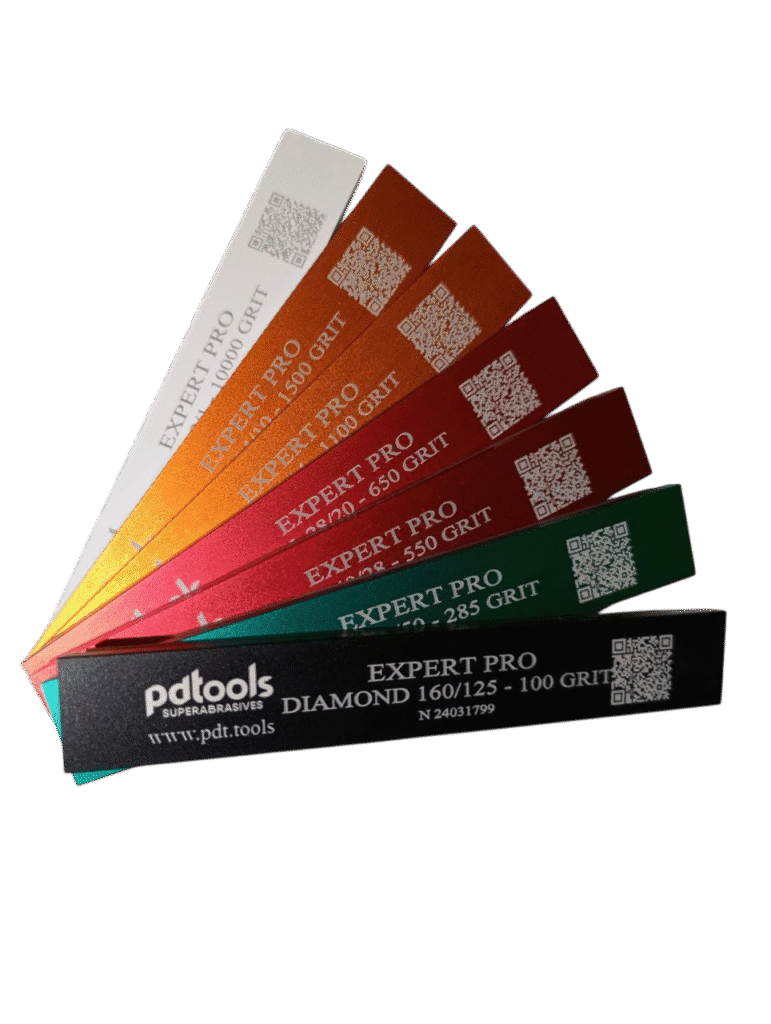
We offer super high-quality diamond and CBN sharpening stones in the following sizes: 3×8‘, 1×6’ and 0.5×6‘ for all types of knives. The most popular for manual sharpening are 3×8’ bars.
PDT Expert Pro CBN Stone
The process of sharpening with diamond and CBN stones is simple:
Apply soapy water (with your finger or from a spray bottle) or oil to the surface of the stone. You can sharpen without anything — dry.
Place the stone on a flat surface.
Apply the knife to the bar at a certain angle (usually 10-20°) and run the blade across the stone away from you, then back again.
Sharpen both sides of the blade evenly and with the same amount of force.
Start with a coarse sharpening stone, then move on to a stone with a finer grain to finish the blade.
PDT Expert Pro Diamond Stone
Advice from UKSG.tools
We offer top-quality bench stones, freehand stones/sharpeners for all types of knives. They are manufactured by leading manufacturers: PDTools (Poltava Diamond Tools) and KDTU (Kyoto Diamond Tools Ukraine).
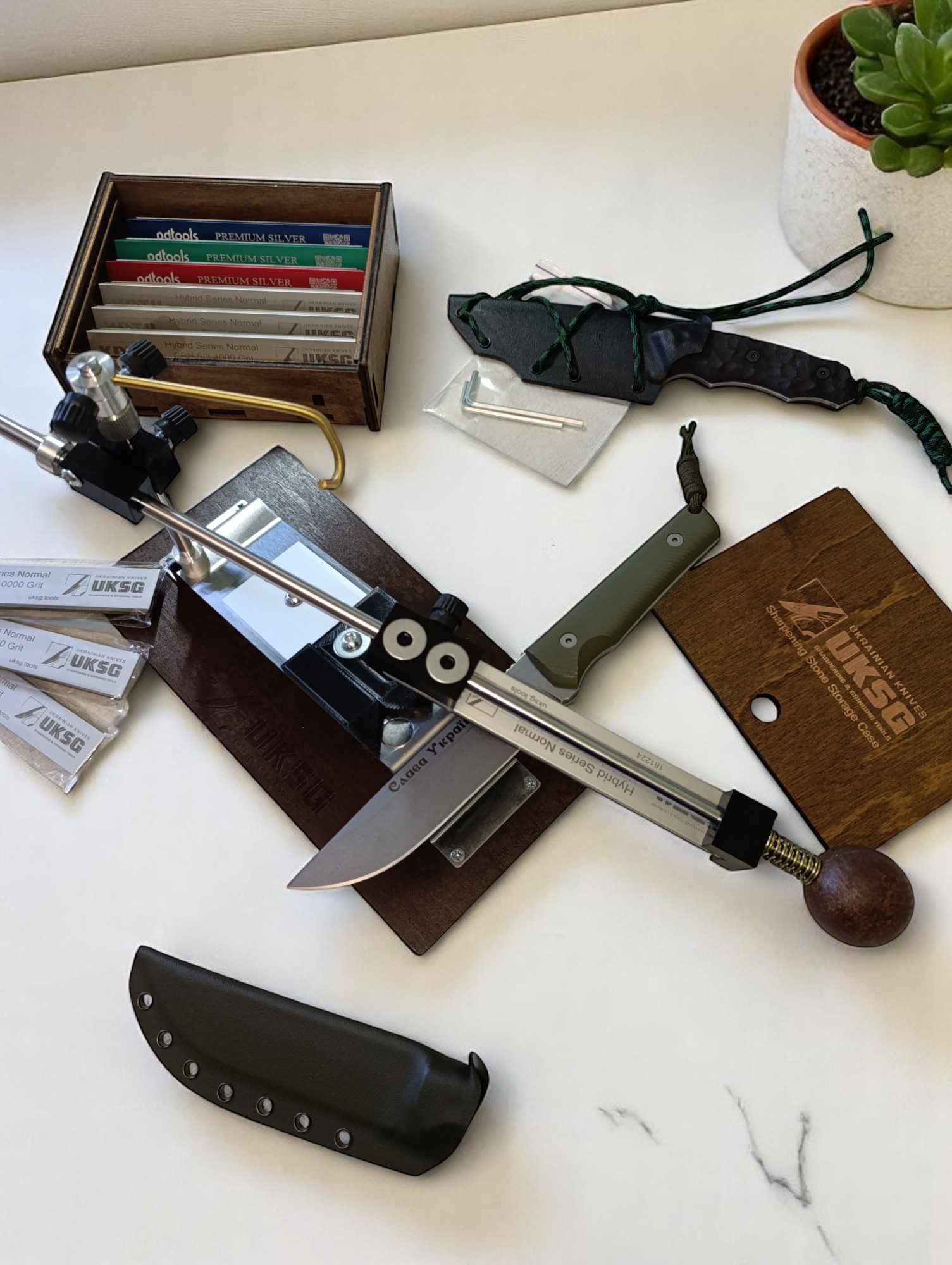
Fixed angle sharpening system (sharpener) or guided system – the best option for a stable angle
This is a mechanical sharpener with a rack and pinion mechanism for adjusting the sharpening angle. The device can be either stationary, attached to a table, or portable.
The main advantages of such sharpeners are:
Stable and compact design made of metal and high-strength plastic.
The guides simplify the sharpening process: they precisely adjust the angle for perfect results.
Suitable for scissors, kitchen knives, pocket knives, hunting knives and bushcraft knives.
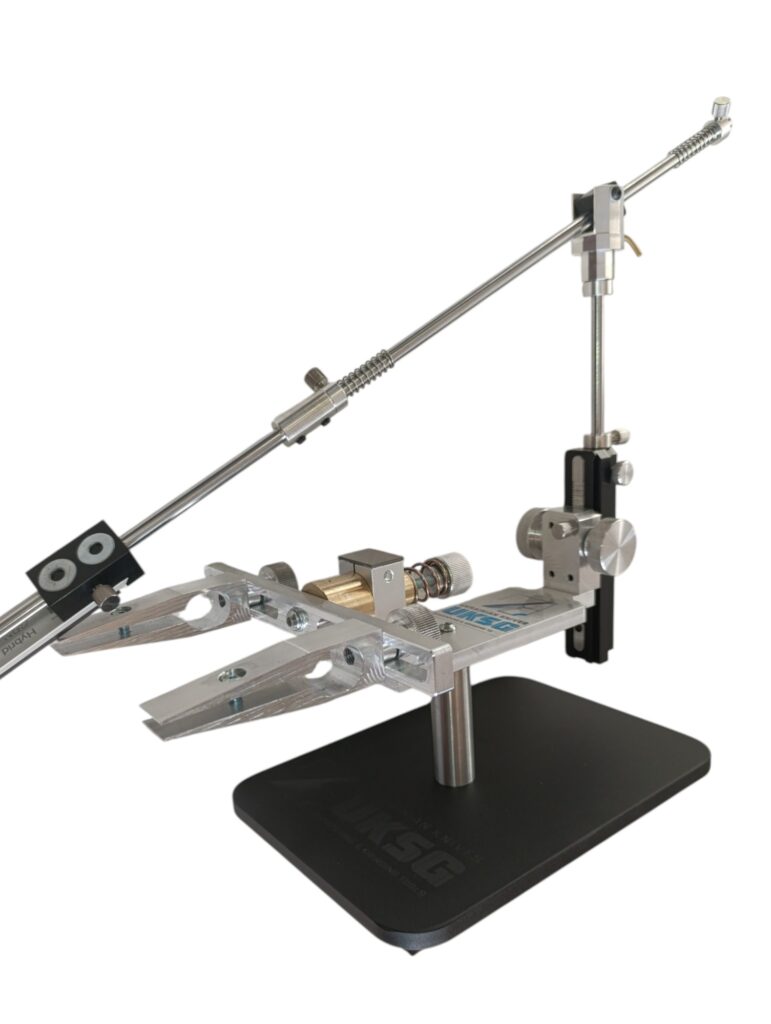
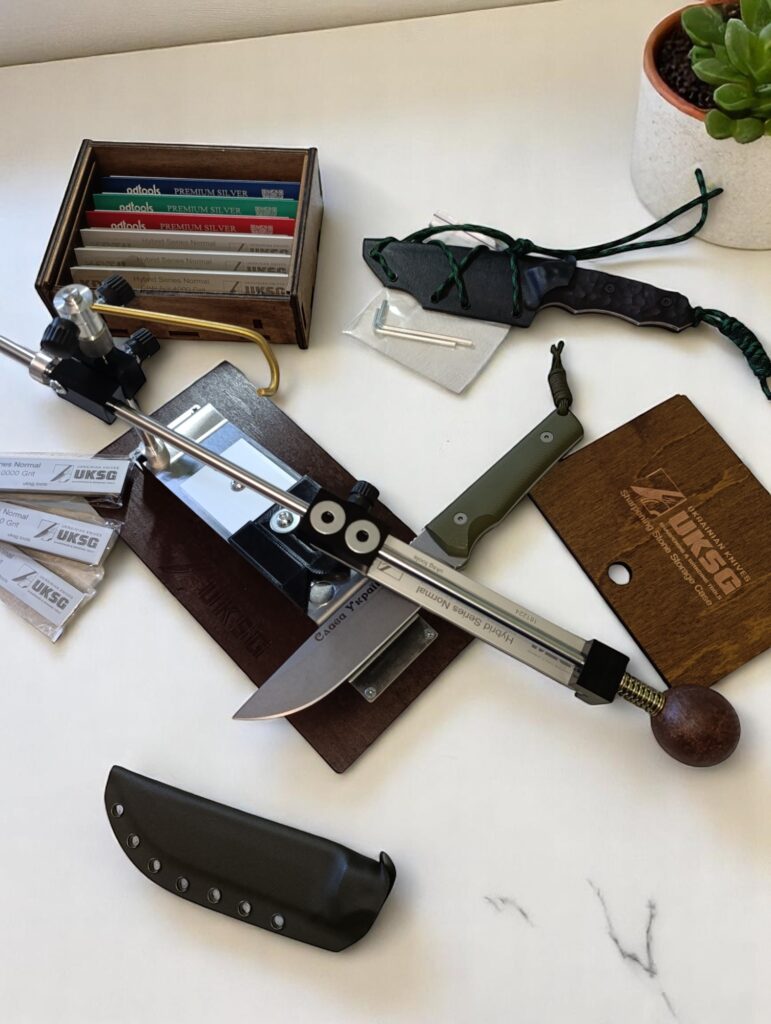
UKSG TRYZUB Sharpener with Guides
Advice from UKSG.tools
The UKSG TRYZUB Sharpener with guides is excellent at sharpening different types of blades. It has a sharpening angle range from 8° to 35°, a universal clamping system and a sturdy metal base.
Magnetic sharpeners are easy to use and give results even without experience
This type of sharpener uses a magnet to hold the knife in place. It securely holds the knife at a specific angle during sharpening. The angle can be adjusted.
Advantages of magnetic sharpeners:
Magnetic fixation makes the sharpening process simple and convenient, especially for beginners.
The magnet ensures the correct sharpening angle, so metal is removed evenly along the entire length of the blade.
There is very little chance of cutting yourself, as the knife is securely fixed in place.
Ideal for home kitchens.
Sharpener UKSG Magnetic Sharpex
Advice from UKSG.tools
If you want to sharpen knives at home quickly and accurately, without clamps or complicated settings, use UKSG Magnetic Sharpex. This magnetic table system is designed specifically for home kitchens, but gives professional results. Suitable for all standard stones.
Electric sharpeners – fast, but not always accurate and often burn the edge
These devices are designed for quick and effective sharpening of knives using an electric motor. It drives abrasive discs or belts.
Sharpening does not require any special effort or skills.
Some models have an adjustable sharpening angle and several modes for different degrees of knife dullness.
To prevent injuries, they are often equipped with protective elements.
Suitable for kitchen knives, hunting knives and folding knives.
They require careful handling: excessive pressure on the blade can remove a large amount of metal.
Need to quickly sharpen a knife blade? A honing rod can help
Honing rods or sharpening steels are made of steel, ceramic or diamond coating. They are useful for professional chefs and home cooks, as well as for hunting and fishing as an alternative to field sharpeners.
It is used to maintain the sharpness of a knife blade.
It helps to remove microscopic irregularities on the cutting edge: when using a knife, the edge may bend or deform slightly. The honing rod evens it out, making the knife sharper.
The tool is not designed for sharpening blunt knives. A honing rod is not a substitute for proper sharpening. If the blade is severely dull or chipped, sharpening stones must be used.
Sharpening a knife is not difficult if you choose the right tool. Our sharpening experts will help you choose the best tool for sharpening your knife or knife set. To do this, contact us by email at info@uksg.sale or submit a request for selection on the website.
Each blade requires its own angle — choose the right one
The sharp part of the blade that actually does the cutting is called the cutting edge. This is what you sharpen. But before you start sharpening, you need to know what sharpening angle to choose.
There is a general principle for all cutting tools:
the sharper the sharpening angle, the thinner and sharper the cutting edge,
and vice versa — the duller the sharpening angle, the stronger the cutting edge.
Therefore, for kitchen knives, choose:
15-20° for sharpening a filleting knife. This results in a thin and sharp edge, necessary for cutting thin slices of meat and fish.
20-25° for thin cutting, such as fruit and vegetables, as well as for working with soft foods.
25-30° provides better cutting edge durability. Suitable for rougher work, such as cutting meat and fish.
20-30° is the best option if you use one knife for all kitchen tasks.
Our recommendations:
When sharpening on both sides, divide the selected angle in half.
If the knife already has a specific sharpening angle, it is better to stick to it so as not to disturb the geometry of the blade.
There are knife sharpeners that help maintain the desired angle.
If you are sharpening with a hand sharpener, do not change the angle during the sharpening process.
Do not press the blade too hard against the abrasive.
Do not sharpen dry if the abrasive requires water or oil.
Tourist, tactical and hunting knives
To sharpen such knives, choose an angle range of 20-35° depending on the type of knife, its purpose and personal preferences.
For example, sharpen a knife for cooking in camp at an angle of 20-25°
For cutting branches and working with hard materials, an angle of 30-35° is suitable
It is important to consider the type of steel: hard steel holds an angle of 20-25° well, while softer steel may require sharpening at a more obtuse angle.
Some users prefer sharper knives. Others value the durability of the cutting edge.
If the knife is used frequently and for various purposes, we recommend choosing a sharpening angle that will provide a balance between sharpness and durability.
Axes and machetes
Choose angles that are suitable for chopping work and ensure the strength of the cutting edge.
For axes, a sharpening angle in the range of 25-35° is suitable: carpentry work — about 25°, chopping wood — about 35°
For machetes — 30-40°
For sharpening, use whetstones, sharpening machines or special sharpening kits.
Advice from UKSG.tools
If you want to keep your knives in perfect condition, you will need a set of sharpening stones. Our diamond and CBN stone sets have different types of bonds and are suitable for all stages of sharpening: from rough grinding to mirror polishing.
Don’t wait until it becomes dull — sharpen it regularly
How often should you sharpen a knife? It all depends on its performance characteristics and frequency of use. The sharper the knife, the easier it is to cut delicate materials, but such blades become dull more quickly.
On average, knives should be sharpened with professional tools at least once a month, even if it seems that the blade does not need it yet.
We have prepared step-by-step instructions (if using the system)
Secure the knife.
Select the desired abrasive (grit).
Start with a coarse stone and finish with a finishing stone.
Work smoothly, without applying pressure.
After sharpening, use polishing paste/belt.
The main thing is a stable angle, high-quality stones and accuracy. Even at home, you can achieve sharpness and a perfect shine.
Our experts will help you choose what you need. In the UKSG.tools catalogue:
Diamond and CBN stones of various grit sizes and bond types
Sharpening kits with diamond and CBN stones
Sharpeners: with guides and magnetic
Accessories and parts for sharpeners
Honing stone with diamond abrasive
Contact us by email at info@uksg.sale or submit a request for selection on the website.
Oleksandr Doroshenko
Oleksandr Doroshenko is the leader and principal expert at UKSG Tools, a Ukrainian manufacturer of specialized sharpening and grinding instruments. Under his leadership, the company focuses on high-precision solutions using diamond and CBN abrasives, blending advanced technologies with the craftsmanship of the country’s finest domestic producers.